A claim asks an insurance company to pay, and a lawsuit asks a court to decide. Most injured people in this state begin with the first and never learn what separates the two until the process stalls. The adjuster stops returning calls, or an offer arrives well below the medical expenses already stacking up.
That is usually the moment the difference starts to matter, because state law sets specific conditions on moving from one to the other. At Fincher Law Injury & Accident Lawyers, our Topeka attorneys weigh those conditions alongside the injuries, the evidence, and the applicable deadlines. You can ask our team to review the status of your case before you sign or accept anything.

Victims of Personal Injury Claim deserve accountability and justice

A personal injury claim is a request for payment sent to an insurance company. No judge reviews it, no jury hears it, and no court file exists. An adjuster employed by the insurer decides what the company is willing to offer.
After a motor vehicle crash, that process usually starts with your own policy. Kansas requires personal injury protection (PIP) coverage, which pays certain losses regardless of who caused the crash. Minimum benefits include $4,500 in medical benefits, $900 per month in disability benefits for up to one year, and $4,500 in rehabilitation benefits under K.S.A. 40-3103.
Once treatment progresses, our team assembles a demand package built from medical records, billing statements, wage documentation, and a written explanation of liability. The adjuster then responds with an acceptance, a counteroffer, or a denial.
A lawsuit moves the dispute out of an insurance office and into a courtroom. Your attorney files a petition, the defendant must answer, and a judge manages the schedule from that point forward. The insurer still pays any resulting judgment in most cases, but it no longer controls the outcome on its own.
The petition is the document that opens the case. It names the defendant, states the facts, and identifies the damages sought.
Filing alone does not finish the job. Under K.S.A. 60-203, an action counts as commenced on the filing date only when service of process is obtained within 90 days after the petition is filed. A court may extend that window by an additional 30 days when the plaintiff shows good cause.
Civil cases are split across different tracks based on the amount claimed. K.S.A. 61-2802 allows actions under the Code of Civil Procedure for limited actions when the amount claimed does not exceed $25,000, excluding costs, interest, and fees.
Small claims sit lower still. Under K.S.A. 61-2703, a small claim cannot exceed $10,000, excluding interest, costs, and any damages awarded. That forum handles the smallest disputes and is not built for cases involving significant medical treatment.
The two processes differ in who decides, what becomes public, and how information changes hands. Understanding those differences helps you judge whether the offer in front of you is reasonable.
Several practical distinctions separate a claim from a lawsuit:
These distinctions explain why the same injury can be worth negotiating in one situation and worth litigating in another.
Three statutes decide whether the option to file is even available to you. Each one operates independently, and missing any of them can narrow your remaining choices.
State law provides two years for an action for injury to another's rights that does not arise from contract, under K.S.A. 60-513(a)(4). The clock does not always start on the date of the crash.
Subsection (b) provides that the cause of action does not accrue until the act first causes substantial injury, subject to an outer limit of 10 years beyond the act. We calculate that date early because a negotiation that drags past it removes the option of litigation.
Fault is divided by percentage rather than shared equally. Under K.S.A. 60-258a(a), contributory negligence does not bar recovery when that party's negligence was less than the causal negligence of the parties against whom a claim is made. Any award is then reduced in proportion to the negligence attributed to that party.
Consider two drivers. A person found 30% responsible recovers 70% of the damages awarded, while a person found 50% responsible recovers nothing at all.
Motor vehicle cases carry one additional requirement. K.S.A. 40-3117 permits damages for pain and suffering only when medical treatment reaches a reasonable value of $2,000 or more, or when the injury falls into a listed category.
Those categories include permanent disfigurement, a fracture to a weight-bearing bone, a compound, comminuted, displaced, or compressed fracture, loss of a body member, permanent injury, permanent loss of a bodily function, or death. Below that threshold, economic losses remain recoverable, and non-economic damages do not.
Litigation rarely begins on day one. In most matters, it follows a sequence that starts with the insurance claim and escalates only when negotiations stall.
The transition generally follows a few stages:
Filing does not end negotiation; it changes the leverage behind it.
If an adjuster has gone quiet or the current offer does not cover your documented losses, call our team at 785-510-2259 to talk through where your case stands.
No single factor decides this question. We weigh the evidence, the injuries, the available insurance limits, and your own tolerance for a longer timeline.
Several signals point toward litigation rather than continued negotiation:
Each signal is fact-specific, and we evaluate them together rather than in isolation.
Many people hesitate to authorize a filing because they picture a courtroom and a witness stand. The reality of civil litigation usually looks different.
Filing a petition opens a process, not a trial date. Mediation, settlement conferences, and direct negotiation continue throughout the case. Many disputes resolve once both sides examine the same evidence, and our team keeps you informed at each decision point.
Discovery is the formal exchange of evidence between the parties. Written questions, document requests, and depositions replace the guesswork that shapes an insurance negotiation. That exchange often surfaces what a claim file never showed, including maintenance records, driver logs, or prior complaints.
These questions often arise once the choice between a claim and a lawsuit becomes real.
Yes. A denial ends the negotiation rather than your legal options, and we can file a petition as long as the statutory deadline has not passed.
You can still recover economic losses such as medical expenses and lost income. Damages for pain and suffering require meeting that threshold or falling within a listed injury category.
Yes. Those benefits apply regardless of fault, and we then pursue the remaining losses from the at-fault driver's insurer.
Yes, because 40% is less than the fault assigned to the other side. That same 40% would then be deducted from your award.
Two years from the date the cause of action accrues in most injury matters. We calculate the exact date early, since accrual is not always the crash date.
It can be, for claims that do not exceed $10,000. That forum suits small property or minor injury disputes rather than cases involving significant treatment.
Learn what is the difference in Personal Injury Claims vs Lawsuits
If your medical treatment has crossed the $2,000 no-fault threshold, the range of damages available to you has changed.
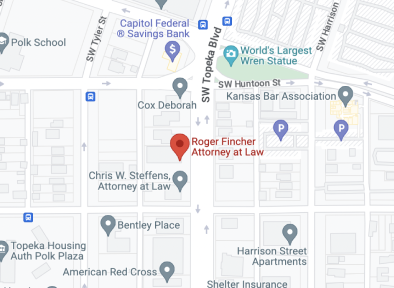
Our attorneys, Roger Fincher and Jennifer Bradford, handle personal injury matters from our Topeka office. We review the treatment records, the fault allocation, and the filing deadline together, then explain the options that fit those facts.
You decide whether to keep negotiating or to file, and we tell you what each path realistically involves. Our team answers questions about the process before you commit to anything.
Call us at 785-510-2259 or reach out through our contact page to schedule your free case evaluation.
Schedule Your
Free Consultation



How Can We Help You?
How Can We
Help You?
Schedule a Free Consultation Now By Contacting
Our Team at (785) 430-5770 or by completing the form below
Schedule a Free Consultation Now
By Contacting Our Team
at (785) 430-5770
"*" indicates required fields